
 English
 Français
 Deutsch




































Setting up and managing an EPA compliant with IEC 61340-5-1
Flooring, workstations, furniture, signage, tools and ESD cleaning: everything you need to know to design, equip and maintain an effective electrostatic protected area.
Layout and boundaries
How do I physically mark out an EPA?
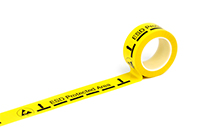
An EPA must be clearly marked out and signposted in accordance with IEC 61340-5-1. Boundaries can be marked with ESD floor marking tape (special dissipative or antistatic adhesive tape), barriers, or changes in floor covering. Entrances must be marked with standardised signs (ESD symbol) indicating the precautions to be followed. Signage must be visible and understandable by all staff.
What types of flooring are compatible with an EPA?
Several solutions are available depending on site constraints. ESD floor mats (laid directly on the existing floor and connected to ground by a cable) are the most flexible solution. Permanent floor coverings (dissipative vinyl or resin) are preferred for new installations or renovations. Treated conductive concrete floors are also used in heavy industry. In all cases, floor resistance must meet the requirements of IEC 61340-5-1 and be checked periodically according to IEC 61340-4-1.
How do I connect EPA equipment to the common ground?
All conductive items in an EPA must be connected to the same common ground point via ground cords with current-limiting resistors. Worksurfaces, trolleys, shelving, production equipment and floor mats are connected via wall-mounted ground points or ground bars. Bringing all items to the same potential is the key to avoiding the potential differences that cause discharges.
Can insulating materials be present in an EPA?
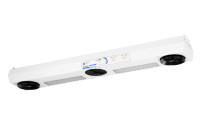
IEC 61340-5-1 prohibits uncontrolled insulating materials near sensitive components in an EPA (standard plastic packaging, cups, ordinary paper, etc.). If insulating materials are unavoidable in the process, they must be treated with ionisation to neutralise the charges they generate or accumulate. Each exception must be documented in a risk assessment.
ESD workstations and furniture
What are the characteristics of a compliant ESD worksurface?
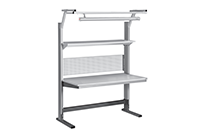
A compliant ESD worksurface must have a surface resistance between 10^6 and 10^9 ohms, measured according to IEC 61340-2-3, and a resistance to ground below 10^9 ohms. It must be connected to the common ground by a ground cord with a current-limiting resistor (1 MΩ). The surface must be lint-free, resistant to common solvents and easy to clean. The legs and metal frame must also be grounded.
Do storage cabinets and shelving also need to be ESD?
Yes. Any furniture or shelving in contact with sensitive components or their packaging in an EPA must be dissipative and grounded. Standard metal structures (steel, aluminium) are acceptable if they are properly grounded. Surfaces in contact with components (shelves, trays) must be covered with a dissipative or antistatic material.
Do handling trolleys need to be ESD?
Yes. Trolleys used to transport sensitive components within an EPA must be dissipative, with conductive or dissipative wheels to maintain the ground connection while moving. The resistance of the complete trolley (through the wheels to the ESD floor) must be checked and compliant. Handles must also be dissipative if they are in contact with the operator.
ESD tools and supplies
Are specific ESD tools needed in an EPA?
Yes. All tools in direct contact with sensitive components or their connections (tweezers, screwdrivers, brushes, spatulas) must be dissipative or conductive and grounded. Standard insulating tools accumulate charges that can discharge into components on contact. Eurostat offers a range of ESD tools for operators, covering common assembly and handling needs.
Which office supplies are compatible with an EPA?
Ordinary office supplies (pens, pencils, notebooks, standard plastic sleeves, labels) are generally insulating and must not be used near sensitive components in an EPA. ESD alternatives exist: dissipative pens, antistatic document sleeves, antistatic labels, ESD document holders. The rule is simple: anything that comes near a sensitive component must be ESD, or its use must be justified by a risk assessment.
How do I clean an ESD workstation without damaging it?
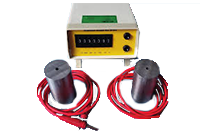
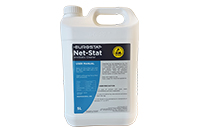
ESD workstations must be cleaned with compatible ESD cleaning products, lint-free antistatic cloths and dissipative brushes. Avoid ordinary household products, which can leave insulating residues on dissipative surfaces. After cleaning, check the electrical properties with a resistance meter. Some ESD cleaning products also contain an antistatic agent that restores or maintains surface properties.
ESD signage
What are the standardised ESD symbols and what do they mean?
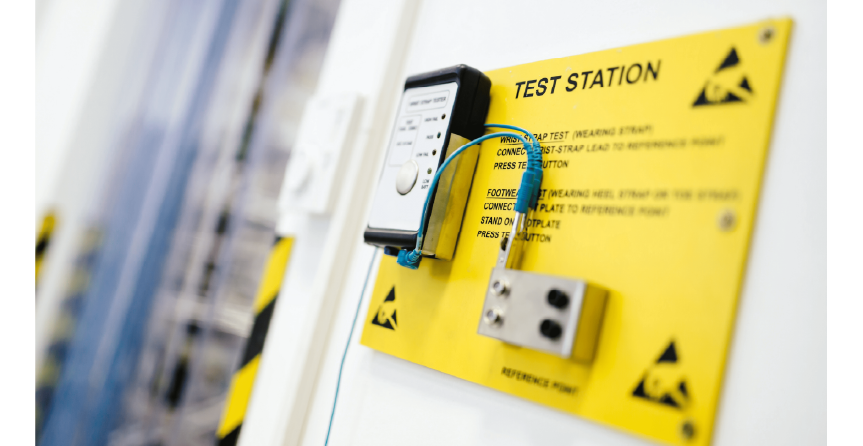
Two symbols are defined by IEC 61340-5-1. The ESD susceptibility symbol (a hand with a slash through it, inside a triangle) indicates that a component or package is sensitive to electrostatic discharge and requires precautions. The ESD protective symbol (a hand inside a triangle, with an arc above it) indicates that a product or area provides protection against ESD. These symbols must appear on packaging, equipment and EPA signage.
Do labels and signage tapes need to be ESD?
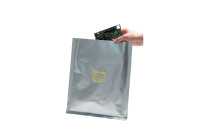
Labels and marking tapes used directly on sensitive components or their packaging must be antistatic so that they do not generate charges when applied or removed. For floor marking or signs located away from components, standard products may be acceptable if their position does not create an ESD risk. Eurostat offers a range of compliant ESD packaging and signage.